Index
- PrologueThe Day the Tap Ran Dry
- Ch. 1The Personal Price of Vision
- Letter to the Reader
- Part I — The Awakening
- Ch. 2Why Self-Sufficiency Is Not Escape, It Is Strategy
- Ch. 3Answering the Hard Questions
- Ch. 4The Economics of Self-Sufficiency
- Ch. 5The Psychological Cost of Dependence
- Ch. 6The Friction Period
- InterludeThe Moment You Stop Reading
- Part II — Household Systems
- Ch. 7The Garden
- Ch. 8The Home Pantry
- Ch. 9The Fermentation Revolution
- Ch. 10Natural Cleaning and Hygiene
- Part III — Building the Infrastructure
- Ch. 11Water Sovereignty
- Ch. 12Energy Sovereignty
- Ch. 13Sanitation and Fertility
- Practice and Closing
- PracticeYour First 30 Days
- What Comes Next
- AppendixStructuring a 20-Person Nucleus
- Toward Book 2
The Day the Tap Ran Dry
The moment dependence becomes visible.

The sound starts low, an almost imperceptible hum beneath the city's constant noise. It is the electric hum of modern life: the fridge, the server in the corner of the room, the neighbor's air conditioner. You wake up, not to the sun, but to the cold blue light of your phone screen. The coffee is instant, the water comes from a filter you have never opened, and the bread, soft and flavorless, comes out of a plastic bag.
You get into your car, a cocoon of metal and glass, and join a river of other cocoons in a maze of asphalt. Always rushing, always late for a job where you move bits of information from one screen to another. At lunch, food arrives in a box, delivered by an anonymous face that vanishes as quickly as it appeared. Everything is easy. Everything is fast. And nothing, absolutely nothing, is under your control.
You feel a tiredness that sleep does not cure. An anxiety that the next online purchase does not soothe. It is the subtle but persistent sense of being a passenger in your own life. The realization that every calorie you eat, every watt of energy you use, every drop of water you drink depends on a chain of events so complex and fragile that you cannot even begin to understand it.
Now, contrast that.
Imagine waking to soft sunlight coming through the window, not to the shrill sound of an alarm. The only sound is the crackle of firewood in the stove, a living, warm sound. You step barefoot onto the cold earth outside, feeling the morning dew. The smell is of green, of rain, of life. The water you drink comes from the rain that fell on your roof, filtered by a system you built yourself, and it tastes clean, mineral. The bread you eat has a thick crust and a dense crumb, made with a starter you have fed for years and baked with the heat of the wood you cut. The egg came from the hen you can hear scratching outside. The day's work is not moving bits, it is moving earth, building, repairing, creating. It is physical. It is real. The sweat on your face has a clear purpose.
There is no magic. There is no utopia. There is only cause and effect. There is a direct, undeniable connection between your effort and your survival, between your knowledge and your quality of life.
I understood this while sitting on my kitchen floor at three in the morning, with my hand bleeding.
I had just broken a glass trying to wash the dishes in the dark. The power had gone out. It was not the first time, but it was the first time the silence that followed felt heavy, absolute. I could not wash the dishes. I could not shower. I could not cook. My phone, my window to the world, was dying, and I had no way to charge it.
I had money in the bank. I had companies. I had "security". But in that moment, sitting in the dark, with the metallic smell of my own blood in the air, I understood the depth of my helplessness: I had control over nothing.
I was an expert in an abstract field, but illiterate in the basic skills of living. If the power grid went down for a week, for a month, I would be lost. I, a grown, educated, successful man, would be unable to care for myself.
It was that night the journey began. Not with a grand plan, but with a simple, frightening question: if everything stopped tomorrow, how long would I survive? The answer terrified me.
This book is about the journey from the first scenario to the second. It is not a journey back in time, but a journey back to reality. It is about the decision to stop being a passenger and become the pilot.
The Personal Price of Vision
Vision has a price, and it is worth every cent.

People see the result, but they do not see the process. They see the finished house, the productive garden, the systems running on their own. They see material independence and assume it came from a romantic ideal or a natural affinity for the land. What they do not see is that this was built as a direct response to an entire decade living inside the system I believed was the only possible path.
I did not grow up knowing how to plant, build, or structure water and energy. I grew up learning to compete, to perform, and to produce results. For ten years, I did exactly what I had been taught winning meant. I worked obsessively, built companies, grew revenue, and accumulated responsibilities. I learned to operate within the market with efficiency and discipline. I became good at the game. And I won.
The problem is that the victory did not bring the freedom I had imagined. It brought complexity, structural dependence, and a constant level of demand that never let up. The more I grew, the more the system demanded of me. Expansion did not reduce my vulnerability, it only made it more sophisticated.
The night I cut myself in the kitchen was not just a household accident. It was the concrete realization that I knew how to structure complex businesses but did not know how to secure my own base. I depended entirely on invisible chains I did not control. I generated money inside the machine but did not know how to exist outside it. That realization was brutal because it exposed something financial success had masked: I was efficient, but I was not independent.
Between that night and the house you see today there was a process of rupture. And there was a price.
The Cost of Time
I spent ten years trying to win inside a system that defined value solely by growth and accumulation. It was not just about working, it was about constantly proving I was capable. I internalized the idea that time only had value if it was producing a financial or strategic return. Rest felt like waste. Standing still felt like failure.
But time does not pause while you chase goals. Relationships change. People move on with their lives. And you change too, just in another direction. I became more efficient, more disciplined, and more distant. Not only physically, but emotionally. I was deeply present in the market and progressively absent from myself. Today I understand I was not accumulating advantage, I was accumulating postponement.
The Financial Cost
I made money, and that makes the story uncomfortable. This is not someone who failed and decided to criticize the system out of resentment. I learned to generate revenue, structure businesses, and expand operations. Every goal reached reinforced the story that I was on the right path.
However, financial growth came with a proportional expansion of responsibility. More contracts meant more dependencies. More revenue meant more fixed obligations. Employees depended on me. Clients expected consistency. The machine had to run every single day. What began as entrepreneurial freedom evolved into an ecosystem that demanded my permanent attention just to keep existing. It took me years to realize I had built something that needed me more than I needed it.
The Emotional Cost
The greatest cost was internal. From the outside, it looked like strength. From the inside, it was constant tension. I confused anxiety with ambition and exhaustion with merit. Never being satisfied was interpreted as discipline. The system rewards those who keep running, not those who question the race.
When I finally reached what once seemed distant, I noticed something unsettling: I had results, recognition, and structure, but I had no lightness. The crisis was not financial. It was existential. Admitting I had won inside a model that did not represent my values was harder than any failure would have been. That was the point where I understood that winning inside a system is not the same as being free.
Why It Was Worth It
I did not build this house out of romanticism or passing frustration. I built it as a deliberate act of rupture. After experiencing the top of the growth logic, I realized it did not deliver sovereignty. It delivered continuous performance.
The independence I was after was not only financial. It was structural. It was reducing invisible dependencies. It was knowing how to produce the essentials. It was making sure my survival was not entirely conditioned on the stability of a market I do not control.
It was worth it because today I choose to take part in the market, but I do not depend on it to exist. That difference completely changes your relationship with money, work, and risk. I needed ten years to understand that success without autonomy is just sophisticated dependence. This book exists so that you do not have to learn that lesson the slowest, most expensive way possible.
Letter to the Reader

If you are holding this book, you probably feel the same low hum of dissatisfaction I once felt. A sense that, despite all the modern convenience, something fundamental has been lost.
I want to be direct with you: this book is not for those who want ease. Ease is what brought us here.
This book is for those who want autonomy. And autonomy is not easy. Autonomy is work. Autonomy is responsibility. Autonomy is the willingness to trade the passive comfort of convenience for the active satisfaction of competence.
In the pages ahead, you will not find magic formulas or promises of an effortless life. You will find an instruction manual. A technical guide, yes, but also a philosophical map for rebuilding your life on a foundation of resilience, knowledge, and sovereignty. I will not tell you it is easy. I will show you it is possible. If you are ready to stop outsourcing your life and start building it with your own hands, turn the page. The journey begins now.
The Awakening
Before the tools, the logic. This part answers the question that holds up everything else: why trade comfort for competence? The awakening begins with a question.
Why Self-Sufficiency Is Not Escape, It Is Strategy
Self-sufficiency is strategy, not escape.

This book begins with a confession: I did not arrive at self-sufficiency out of a romantic desire to hug trees or an apocalyptic rejection of the modern world. I arrived here through a cold, logical, at times brutal analysis of the system most of us are embedded in. My journey was not an escape from reality, but a run toward it.
For years I played the game, and I played to win. I accumulated capital, understood the rules of the market, and built a position that, from the outside, looked like the peak of success. Yet the higher I climbed, the clearer the fragility of the structure holding me up became. My financial security depended on a digital banking system I did not control, my food came from supply chains that crossed continents, my energy came from a centralized and vulnerable grid.
I had success, but I had no autonomy. I had resources, but I had no resilience. What good is money in the bank if, when the grid fails, you cannot even boil water? What good is a diversified portfolio if you do not know where your next meal comes from when the supermarket closes? Self-sufficiency is not about rejecting the modern world. It is about not being its hostage. It is about having the ability to choose.
The Illusion of Convenience
Modern convenience is seductive. It promises ease, speed, and comfort. And it delivers, at least in the short term. But convenience has a hidden cost: the progressive loss of competence. Every time you outsource a basic function of life, you lose a little of your ability to take care of yourself. You become more dependent, more vulnerable, more fragile. It does not knock you down immediately. It just makes you more and more dependent, until one day you realize you can no longer live without it.
Control as the Guiding Thread
This book is not only about planting tomatoes or building cisterns. It is about control. Control over what you eat, what you drink, how you live. Over your time, your space, your destiny. Every system you learn to build, every skill you develop, is a step away from dependence and toward autonomy. Self-sufficiency is not the end. It is the means. The end is freedom: the freedom to not fear the future and to live on your own terms.
Strategy, Not Escape
Many people confuse self-sufficiency with isolation. They think becoming self-sufficient means abandoning society, living in a cabin in the woods, and rejecting all modern technology. Nothing could be further from the truth. Self-sufficiency is strategic. It does not reject technology, it uses it intelligently. It does not abandon society, it builds more resilient communities.
The difference between escape and strategy is simple: escape is reactive, strategy is proactive. Escape is driven by fear, strategy is driven by vision. Escape weakens, strategy strengthens. This book is about strategy.
Answering the Hard Questions
Hard questions deserve honest answers.

Before we go further, let us face the skepticism head-on. Because if you are like me, your mind is already forming the hard questions, the objections that seem logical, the "but...". And you deserve honest answers, without evasion.
"Is this an escape from reality?"
No. It is a run toward it. The reality is that the system we live in is fragile, a complex web of interdependencies that can break at any moment. Believing the supermarket will always be stocked, that the power will never fail, and that your job is guaranteed forever, that is the real escape. Building alternatives is pragmatism. It is looking reality in the eye and preparing for it.
"Is this a cult?"
No. Cults require you to hand your power to a leader and follow dogma without question. This book is the exact opposite. It teaches you to take your power back for yourself. The goal is not to follow me, it is to build your own sovereignty. The core idea is autonomy, not submission.
"Is this utopia? Will everything be perfect?"
Far from it. Nature is relentless, systems break, harvests fail, and animals get sick. The fundamental difference is not the absence of problems, but your ability to respond to them. Instead of calling a service line and waiting, you will have the knowledge to diagnose and fix. It is not about achieving perfection, it is about developing the competence to deal with imperfection.
"Does it really work?"
It works, but it is not magic. It takes work, dedication, and, above all, a commitment to continuous learning. The techniques in this book are not theoretical, they are field-tested and refined through years of trial and error. It works for those willing to pay the price of knowledge and effort. It does not work for those looking for an instant solution.
The Economics of Self-Sufficiency
The true cost of dependence goes beyond money.

The Real Cost of Dependence
Our society is addicted to something I call the convenience tax. Every product we buy comes with an embedded cost that goes far beyond the price tag.
The cost of fragility. When you buy a tomato at the supermarket, you are not just paying for the tomato. You are paying for the diesel of the truck that carried it hundreds of kilometers, the packaging, the electricity of the refrigerator that kept it "fresh". You are paying for a long and extremely fragile supply chain. A strike, a spike in oil prices, or a health crisis breaks that chain, and your tomato does not arrive.
The cost of ignorance. By delegating the production of everything we consume, we become functional illiterates of the material world. Not knowing where your food comes from, how your house is powered, or how to fix what breaks is a form of helplessness. We pay specialists for everything, becoming tenants in our own lives.
The biological cost. The convenience economy sells us time but charges us health. Ultra-processed foods, full of preservatives to survive long logistics journeys, make us sick slowly. Self-sufficiency, by contrast, builds the production of health into the routine: work in the garden is exercise, harvested food is nutrition.
The Great Trade-Off: Efficiency vs. Resilience
The modern global system was built on a single pillar: efficiency. The logic of just-in-time and global production chains made incredibly cheap products possible. But we made a fatal mistake: we confused efficiency with robustness.
Efficiency is the ability to do something in the fastest, cheapest way, without waste, in a stable and predictable scenario. A Formula 1 car is the peak of efficiency. Resilience is the ability to absorb shocks and keep functioning even in unstable scenarios. A farm tractor is the peak of resilience.
The current system is a Formula 1 car. It works perfectly on smooth, surprise-free asphalt. But put a small obstacle on the track, a pandemic, a war, a ship stuck in a canal, and the whole system breaks spectacularly. Self-sufficiency is the conscious decision to trade a little efficiency for a lot of resilience. It is building your own tractor.
The Thesis of Inevitable Decentralization
For decades, globalization seemed like a one-way street. Today, we see the first signs that this era is coming to an end. Decentralization is no longer an ideological choice, it is becoming an economic inevitability, driven by three forces:
- The end of cheap energy. Long logistics chains were only viable in a world of abundant, cheap oil. As energy costs rise, transporting a tomato hundreds of kilometers stops making sense. Local production becomes, by pure math, more viable.
- Geopolitical instability. The fragility of global alliances makes it risky to depend on other countries for essential resources. Food, water, and energy security are once again questions of national and, by extension, family security.
- The democratization of technology. The same technology that enabled globalization now enables decentralization. Solar panels, batteries, water filters, and access to information allow individuals to reach levels of autonomy once unthinkable.
The future will not be a regression to the past, but a synthesis. The self-sufficiency of the twenty-first century is not about candles and plows, it is about solar panels and small-scale automation.
The Psychological Cost of Dependence
Dependence builds invisible prisons.
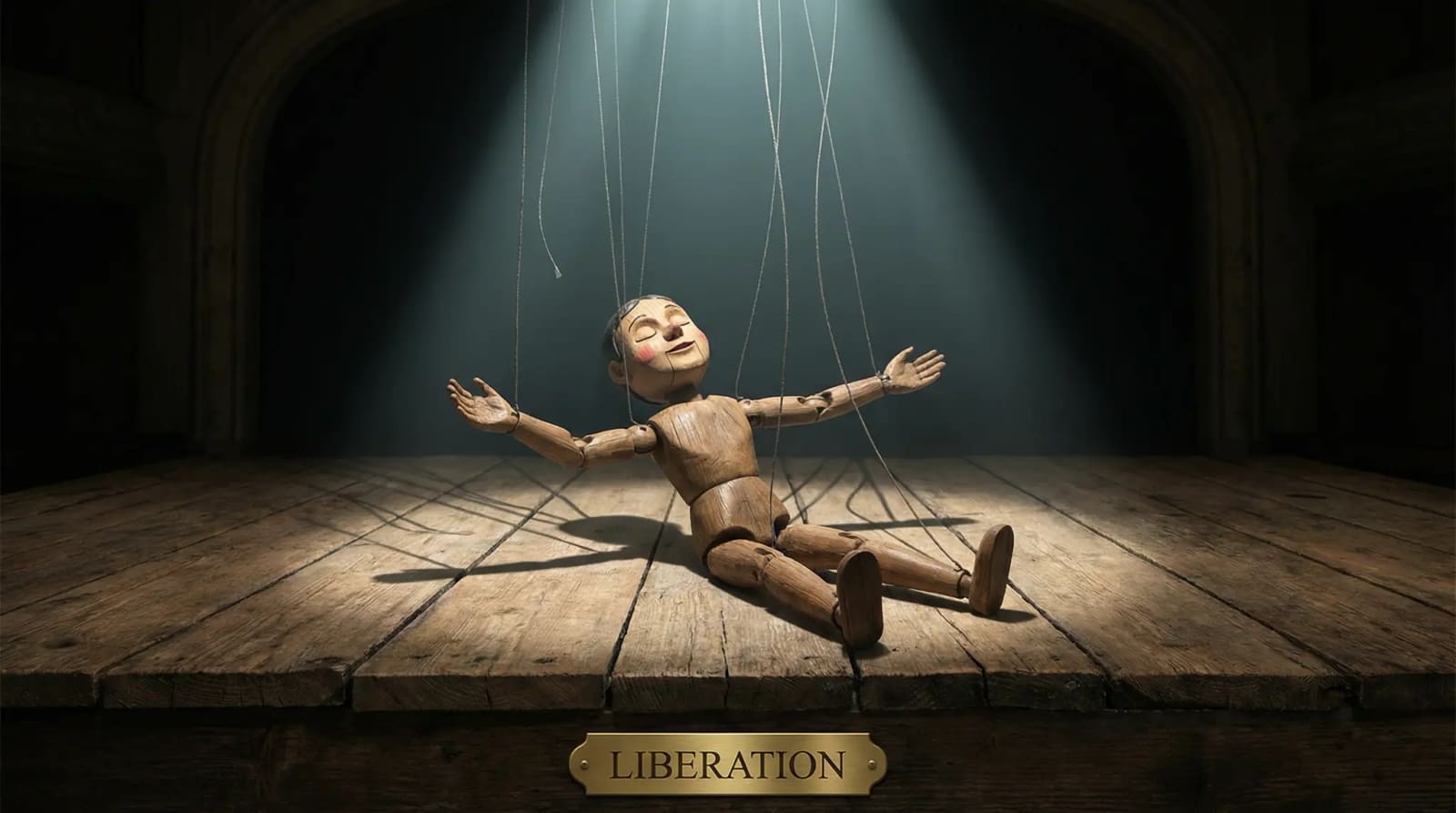
The most insidious form of dependence is psychological. It is a state of mind that settles in slowly, like dust, until it covers everything, suffocating your ability to act, to decide, and, finally, to be.
The Low-Grade Anxiety
You know that feeling. It is the constant, low-grade anxiety humming at the back of your mind. It is not acute panic, it is chronic discomfort: worry about the future, insecurity about your job, doubt about your ability to handle a real crisis. That anxiety is not a flaw of yours. It is a logical response to a fragile system. You feel you have no control, and you are right.
The Atrophy of Competence
Every time you pay someone to do something you could learn, you trade a little of your competence for a little convenience. Repeated thousands of times, that trade atrophies your problem-solving muscle. When something breaks, your first reaction is not "how can I fix this?" but "who do I call?". You become an expert in a small slice of the digital world and a stranger to 99% of the physical reality that sustains you.
The Loss of Meaning
Human beings crave purpose. We need to feel our effort has a visible impact on the world. Extreme specialization made work abstract, disconnected from the final result. You move numbers on a spreadsheet, but you do not see the bread that feeds your family or the water that hydrates you. Self-sufficiency restores that meaning. It reconnects effort and result. Every tomato you harvest, every liter of water you store, is an affirmation of your place in the world.
Freeing yourself from psychological dependence is harder than from material dependence. But it is the only journey that truly matters.
The Friction Period
The hard road is the only one that leads to real freedom.

There is a period, at the beginning, that is deeply frustrating. I call it the Friction Period. It is the moment when you have already abandoned the convenience of the old system but have not yet reached the competence of the new one. It is the worst of both worlds.
What Is the Friction Period?
It is when your first garden yields only a few deformed tomatoes, after months of work, while the supermarket is still five minutes away selling perfect, cheap tomatoes. It is when your attempt at bread comes out a hard, burnt brick. Every task that used to be instant becomes a long project. Everything is slower. Everything is harder. Your brain, addicted to instant gratification, panics and screams: "this is stupid, go back to the easy way". This is the barrier. This is the filter. This is where your conviction is tested.
How to Survive the Friction Period
- Start small. Do not dismantle your whole life in one weekend. Choose a single system: baking your own bread, a small herb garden, a barrel to collect rainwater. Master that system. Use the small win as fuel for the next step.
- Celebrate the process, not just the result. At first, your results will be mediocre. It does not matter. What matters is that you did it, you did not buy it, you did not outsource it. The initial goal is not perfection, it is practice. Competence comes with repetition.
- Keep one foot in the old system. Do not cancel the supermarket on day one. The transition is a bridge, not a leap into the void. Use the old system as a safety net while you build the new one. Little by little, you will depend on it less and less.
- Remember the why. In the moments of greatest frustration, stop, breathe, and remember the helplessness of the dark kitchen. Remember the desire for control, for sovereignty, for a life with more meaning.
The Friction Period is not a sign that you are failing. It is a rite of passage. It is proof that you are truly changing.
Cross it, and on the other side you will find something convenience can never offer: the deep and unshakable satisfaction of competence.
The Moment You Stop Reading

There is a point where continuing to read becomes a form of postponing, and I know this because I was that reader. I bought books on permaculture, on water systems, on natural building. I underlined paragraphs, made notes in the margins, organized the concepts into folders. I understood the theory with a clarity that satisfied me intellectually, and that satisfaction, I realized too late, was a trap. It gave me the sense of progress without demanding the real cost of progress.
The real cost is different. It is the first garden that produced three crooked tomatoes after two months of work. It is the bread that came out with the consistency of concrete. It is the morning I spent forty minutes trying to light a fire with wet wood, while the city gas would have done it in three seconds. No book eliminates that period. What a good book can do is shorten it.
Part II of this book is not philosophy. It is what I learned by failing, refined by repeating, and organize here so you do not have to reinvent every mistake from scratch. These are tested systems, with real costs, real times, and the most common mistakes. Read with a pen in hand. But, more importantly, at some point close the book and begin.
Household Systems
Here theory becomes practice. We start at the origin of everything, the soil that produces the food, and move to the kitchen that transforms and preserves it. These are the first concrete wins that replace the supermarket and build your confidence.
The Garden
All food sovereignty begins with a handful of living soil.
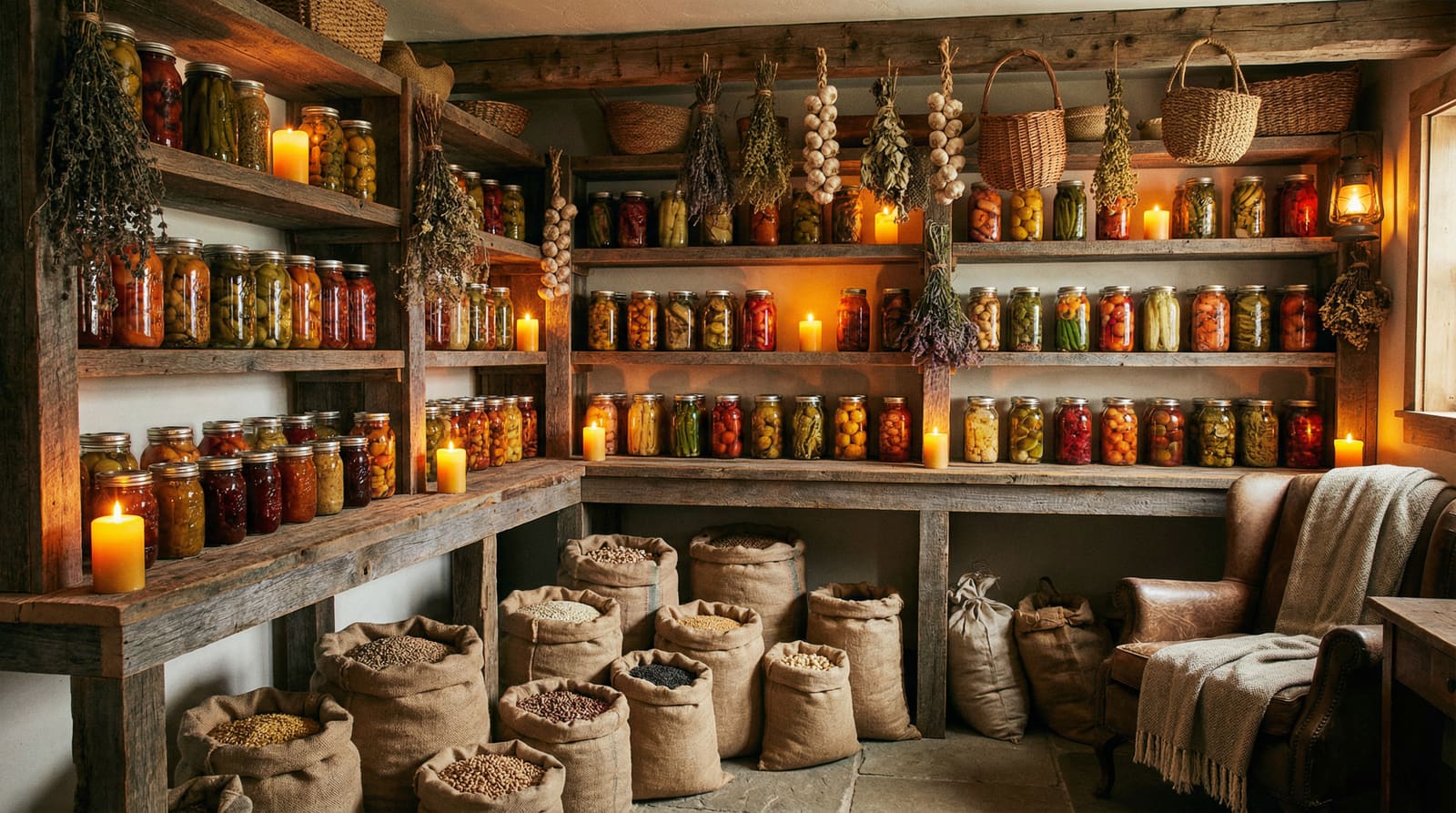
Most people give up on the garden for the wrong reason. They start big, plant twenty things at once, drown in the maintenance, and conclude they "were not born for it". The truth is the opposite. The garden is the most accessible skill in self-sufficiency, as long as you respect one order: first the soil, then the plant.
My first garden was a disaster of ambition. I planted tomatoes, peppers, zucchini, corn, and a handful of other things in the same weekend, convinced that in two months I would be harvesting baskets. I harvested four cracked tomatoes and a handful of caterpillar-eaten leaves, and I gave up the following winter.
When I came back, I started with a single bed of lettuce and chives. The first full salad made only with what came out of my own backyard gave me a pride out of all proportion to its size. It was there, and not in the books I had stacked up, that I became someone who grows food.
7.1 The Soil Is the System, Not the Plant
Beginners tend to the plant. Those who know tend to the soil. Living soil, full of organic matter and microorganisms, grows strong plants almost on its own. Dead soil demands fertilizer, poison, and endless work. The whole secret is in building and feeding that soil.
The raised bed is the simplest way to guarantee good soil from the start, even if the ground in your yard is poor. You build a rectangle (of wood, brick, or even cut barrels), fill it with layers, and plant on top. Drainage is better, you do not step on the soil the roots use, and the harvest sits at waist height.
7.2 What to Plant First
Start with what is hard to get wrong and you use every week. Fast plants give the first win within a few weeks and hold your motivation through the Friction Period.
- Herbs and greens (the quick wins): lettuce, arugula, chives, parsley, cilantro, basil. Harvest in 30 to 45 days, and you cut what you need without pulling the whole plant.
- Everyday tough ones: collard greens, chicory, mustard greens. They produce leaves all year with very little care.
- Leave for later: tomato, pepper, eggplant. They are more demanding (full sun, staking, more pests). Great for the second season, once your hand is trained.
7.3 Composting: Closing the Loop
Composting is the heart of the self-sufficient garden. It turns what would be trash (peels, prunings, dry leaves) into the best fertilizer there is, for free. The rule is simple: alternate layers of green material (wet, rich in nitrogen) with brown material (dry, rich in carbon), keep it moist like a wrung-out sponge, and turn it every one or two weeks to let air in.
Technical Sheet
- Cost
- Low. A bed can be built from reclaimed material; composting is free.
- Time
- Half a day to build a bed; 15 minutes a week of maintenance.
- First harvest
- Greens and herbs in 30 to 45 days.
- Common mistakes
- Starting too big; watering lightly and often (the right way is deep and spaced out); planting tomatoes before mastering greens; forgetting the brown in the compost.
- Return
- High and continuous. One well-tended square meter supplies the household salad.
The Home Pantry
A full pantry is the first form of real wealth.
The pantry is the heart of the kitchen. Turning it from a warehouse of industrial products into a collection of homemade creations is the step that follows the garden: now you preserve the abundance you produced.
8.1 Whole-Food Use
Nature wastes nothing, and neither should we. Whole-food use is the philosophy of using a food completely, from leaves to roots, from peels to seeds. It is a shift in mindset that fights waste, saves money, and discovers new flavors.
- Stems and leaves. Broccoli and cauliflower stems, carrot, beet, or radish leaves are delicious. Chop them fine and use in sautés, soups, or mixed into rice.
- Peels. Potato and sweet potato peels, well washed, can be roasted with oil and salt until crispy, becoming chips. Citrus peels become the multi-purpose cleaner.
- Seeds. Pumpkin and melon seeds, washed, dried, and toasted with salt, become a nutritious snack.
Technical Sheet
- Cost
- Negative. You create value from what would be trash.
- Implementation
- Immediate. It is a change of habit.
- Common mistakes
- Not washing peels well; using parts already spoiling; over-seasoning and masking the flavor.
- Return
- Immediate, on the very first meal.
8.2 Homemade Jam
A classic way to preserve the flavor of seasonal fruit, turning ripe fruit into a preserve that lasts months.
- Wash and chop 1 kg of fruit.
- In a pan, mix the fruit, 500 g to 1 kg of sugar, and the juice of 1 lemon.
- Cook over low heat until it thickens (it is ready when a little on a cold plate does not run).
- Pour hot into sterilized glass jars, seal, and turn upside down for 5 minutes to create a vacuum.
Technical Sheet
- Cost
- Around a few dollars per kg, depending on the fruit.
- Time
- 1 to 2 hours.
- Yield
- 1 kg of fruit makes about 3 to 4 jars of 300 g.
- Common mistakes
- Overcooking (turns hard); undercooking (does not set and molds); not sterilizing the jars.
- Return
- 2 to 3 months.
8.3 Pickles
An ancient technique of preserving in vinegar. Almost any vegetable becomes a crunchy, tangy pickle.
- Wash and cut the vegetables (cucumber, carrot, onion).
- Arrange the vegetables and spices (dill, mustard, garlic) in sterilized glass jars.
- Boil 1 part vinegar to 1 part water, with 1 tablespoon of salt and 1 of sugar per 500 ml.
- Pour the hot brine over the vegetables until covered. Seal and keep refrigerated for at least 3 days.
Technical Sheet
- Cost
- A couple of dollars per 500 g jar.
- Time
- 30 minutes of prep + 3 days of waiting.
- Common mistakes
- Vegetables not submerged (mold); iodized salt (turns cloudy and soft); vegetables not fresh.
- Return
- 1 to 2 months.
The Fermentation Revolution
Fermentation is the alchemy of self-sufficiency.
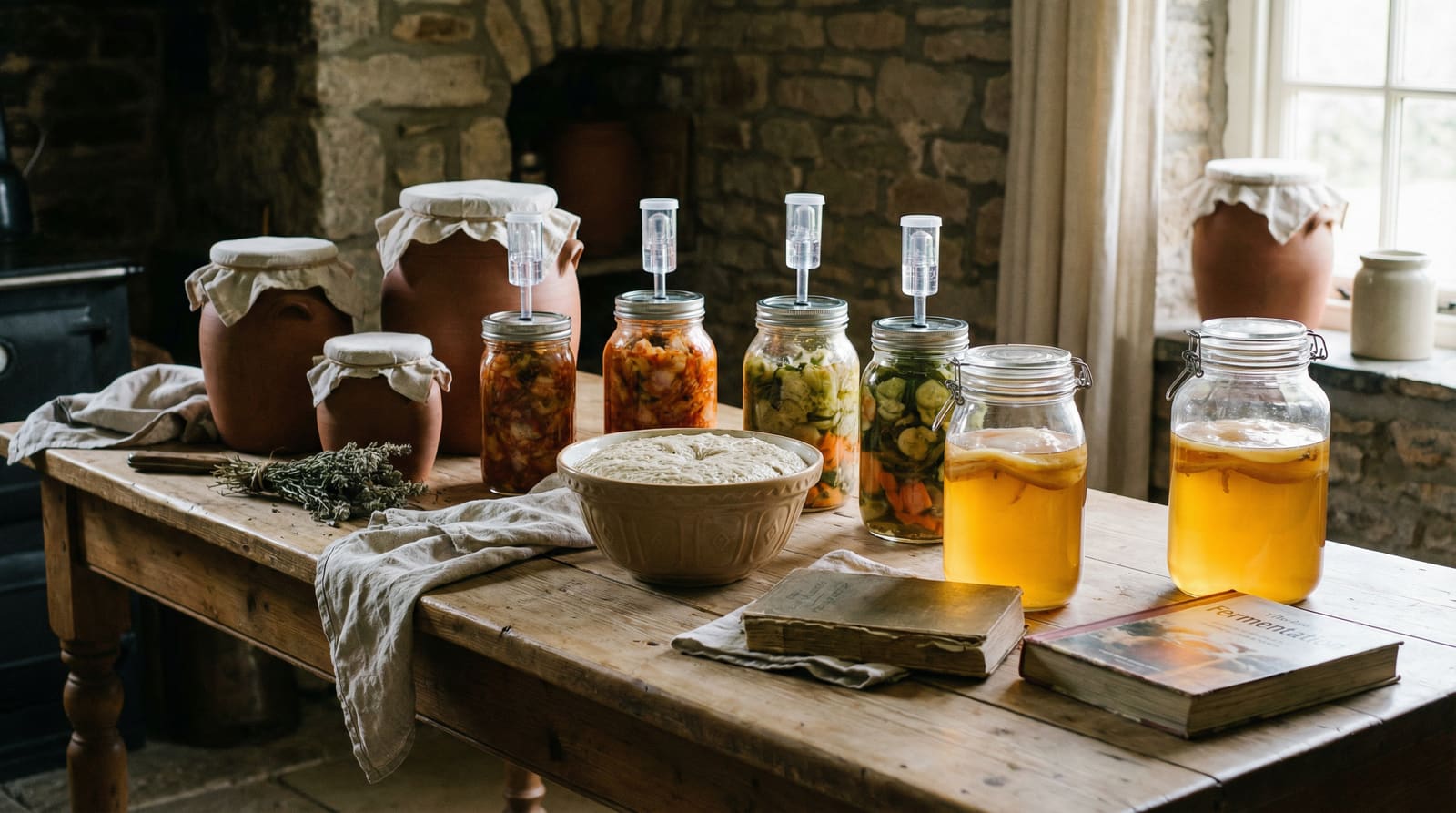
To ferment is to transform. It is inviting beneficial microorganisms into the kitchen to pre-digest food, create complex flavors, and preserve it for a long time. This is the doorway to homemade probiotics.
9.1 Natural Starter (Sourdough)
The sourdough starter, or mother dough, is a living culture of wild yeasts and bacteria that replaces industrial yeast, producing bread with more digestibility and flavor.
Maintenance: frequent use, feed daily with 50 g of flour and 50 g of water; occasional use, keep in the fridge and feed once a week.
Technical Sheet
- Cost
- A few dollars of flour to start.
- Time
- 7 days to create.
- Yield
- A well-kept starter lasts years.
- Common mistakes
- Chlorinated water (kills the yeast); not feeding regularly.
- Return
- 1 month.
9.2 Homemade Sourdough Bread
- Autolyse (1 hour): mix 500 g of flour with 350 g of water and let it rest.
- Incorporation: add 100 g of active starter and 10 g of salt.
- Bulk fermentation (4 to 6 hours): fold every 30 minutes during the first 2 hours.
- Shaping: shape and place in a proofing basket.
- Final proof (2 to 4 hours, or overnight in the fridge).
- Baking: oven at 250°C with a cast-iron pot inside. Transfer the dough, score it, cover, and bake for 30 minutes; remove the lid and bake for another 15 to 20 minutes.
Technical Sheet
- Cost
- A couple of dollars per loaf.
- Time
- 8 to 12 hours (most of it is waiting).
- Yield
- 1 loaf of about 700 g.
- Common mistakes
- Weak starter; dough too wet; cold oven.
- Return
- 2 weeks.
9.3 Milk Kefir
Kefir grains are a symbiotic colony that turns the lactose in milk into a probiotic yogurt, slightly tangy and fizzy.
- Place 1 tablespoon of kefir grains in a glass jar with 500 ml of milk.
- Let it ferment at room temperature for 12 to 24 hours.
- Strain the yogurt, saving the grains for the next cycle.
Technical Sheet
- Cost
- Grains are usually given away. The only cost is the milk.
- Yield
- 1 tablespoon of grains produces 500 ml every 24h; the grains multiply 10 to 15% per cycle.
- Ideal conditions
- 20°C to 25°C. Above 30°C fermentation speeds up and separates the whey.
- Common mistakes
- Metal utensils; fermenting too long; washing the grains in running water.
- Return
- Immediate.
Natural Cleaning and Hygiene
Clean with what nature offers.

The shelves of cleaning and hygiene products are full of harsh chemicals, plastic packaging, and inflated prices. With basic ingredients like vinegar and baking soda, you can make products that are efficient, cheap, and ecological.
10.1 Citrus Multi-Purpose Cleaner
- Fill a glass jar with citrus fruit peels.
- Cover completely with white vinegar.
- Leave in a dark place for 2 to 4 weeks.
- Strain and dilute 1 part of the infused vinegar with 1 part water in a spray bottle.
Technical Sheet
- Cost
- Only the vinegar.
- Yield
- 1 liter of vinegar makes 2 liters of cleaner.
- Common mistakes
- Peels exposed to air (they mold); using it on marble or granite (the acid corrodes the stone).
- Return
- Immediate. Far cheaper than the commercial cleaner.
10.2 Liquid Laundry Soap
- Grate 100 g of coconut soap bar.
- Boil 1 liter of water and dissolve the grated soap.
- Add 3 tablespoons of baking soda and 3 of vinegar.
- Let it cool and add another 4 liters of water. Optional: 20 drops of essential oil.
Technical Sheet
- Cost
- A few dollars to make 5 liters.
- Time
- 30 minutes.
- Common mistakes
- Getting too thick (add hot water); separating into layers (blend with a mixer); using too much soap per wash.
- Return
- Immediate.
Building the Infrastructure
If Part II was about taking back control of your kitchen, Part III is about taking back control of your house and your land. Water, energy, and sanitation: the pillars your sovereignty rests on. The infrastructure of freedom is built brick by brick.
Water Sovereignty
Whoever controls the water controls life.
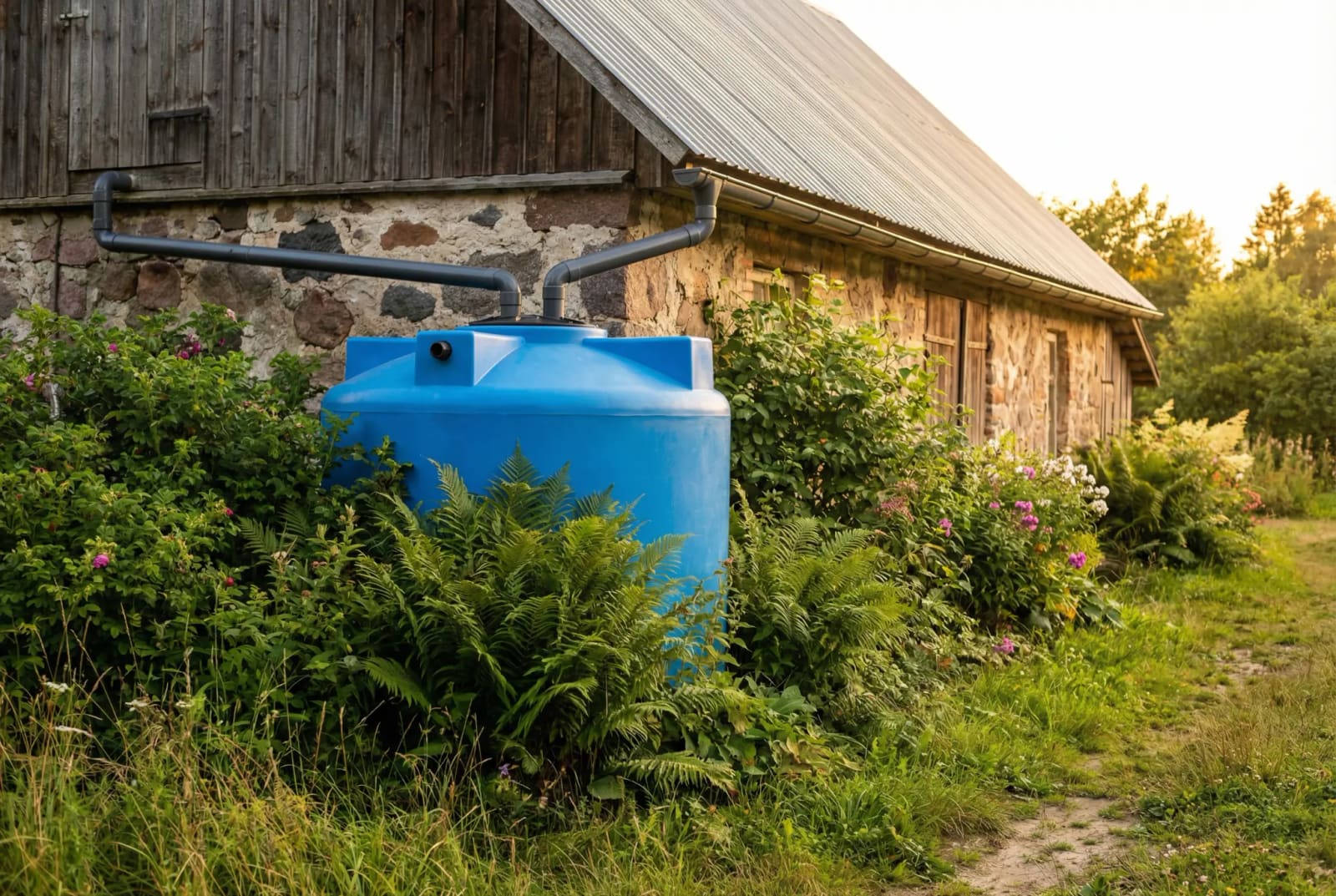
Water is life. Depending on a municipal source is one of our greatest vulnerabilities. Learning to capture, store, and purify your own water is not just security, it is reconnecting with the most fundamental cycle in nature.
11.1 Rainwater Harvesting
The water that falls from the sky is a free, high-quality resource. Capturing it is the first step to water independence.
- Gutters: install gutters on every available roof.
- Primary filter: at the downpipe, install a filter for leaves and debris.
- First-flush diverter: a 100 mm pipe with a screw cap at the base works well: the dirty water fills the pipe, and the clean water that comes after goes to the cistern.
- Cistern: store in a polyethylene tank, a ferrocement tank, or an underground cistern.
A quick calculation helps to size it. Every millimeter of rain yields about 1 liter of water per m² of roof. In practice, count on close to 0.8 liter of usable water per m² per mm, after subtracting the first flush and losses from splashing and evaporation. A 100 m² roof under 30 mm of rain then captures somewhere around 2,400 usable liters. Underestimating this volume is the most common mistake: rain yields far more than intuition suggests.
I almost ruined my first cistern out of haste. I thought the first-flush diverter was a dispensable detail and connected the gutter straight to the tank. Three weeks later, the water had a smell of rotten earth and a scum on the surface: it was all the roof's dirt, bird droppings, and leaves, fermenting in there.
I had to empty two thousand liters, scrub the bottom, and start over from scratch. The diverter pipe I had saved on cost less than a whole afternoon of wasted work. I never skipped that step again.
Technical Sheet
- Cost
- From a simple setup (a 200 L barrel) up to large cisterns.
- Time
- 1 to 3 days.
- Capture
- ~0.8 usable liter per m² of roof for every 1 mm of rain.
- Common mistakes
- Not installing the first-flush diverter; not sealing the cistern (mosquitoes); underestimating the volume you can capture.
- Maintenance
- Clean the gutters and filter every 6 months.
11.2 Purifying Water for Drinking
Harvested rainwater is excellent for irrigation and cleaning. For human consumption, it needs purification. The slow sand filter (biosand) is the most accessible technique.
- Container: a bucket or barrel of 20 to 200 liters.
- Layers, bottom to top: tap at the base; 10 cm of stones (coarse gravel); 10 cm of small gravel; 60 cm of fine sand (pool filter sand is ideal).
- How it works: keep a water layer of 10 to 15 cm above the sand. The water percolates slowly and forms a biofilm on the surface that removes most pathogens.
Technical Sheet
- Cost
- Low.
- Time
- 1 day to build + 2 to 3 weeks for the biofilm to mature.
- Output
- A 200 L filter purifies 20 to 40 liters per day.
- Common mistakes
- Dirty sand; letting the filter dry out (kills the biofilm); flow too fast; skipping the final disinfection.
- Maintenance
- Clean the top sand layer every 6 to 12 months.
Energy Sovereignty
Your own energy is real freedom.
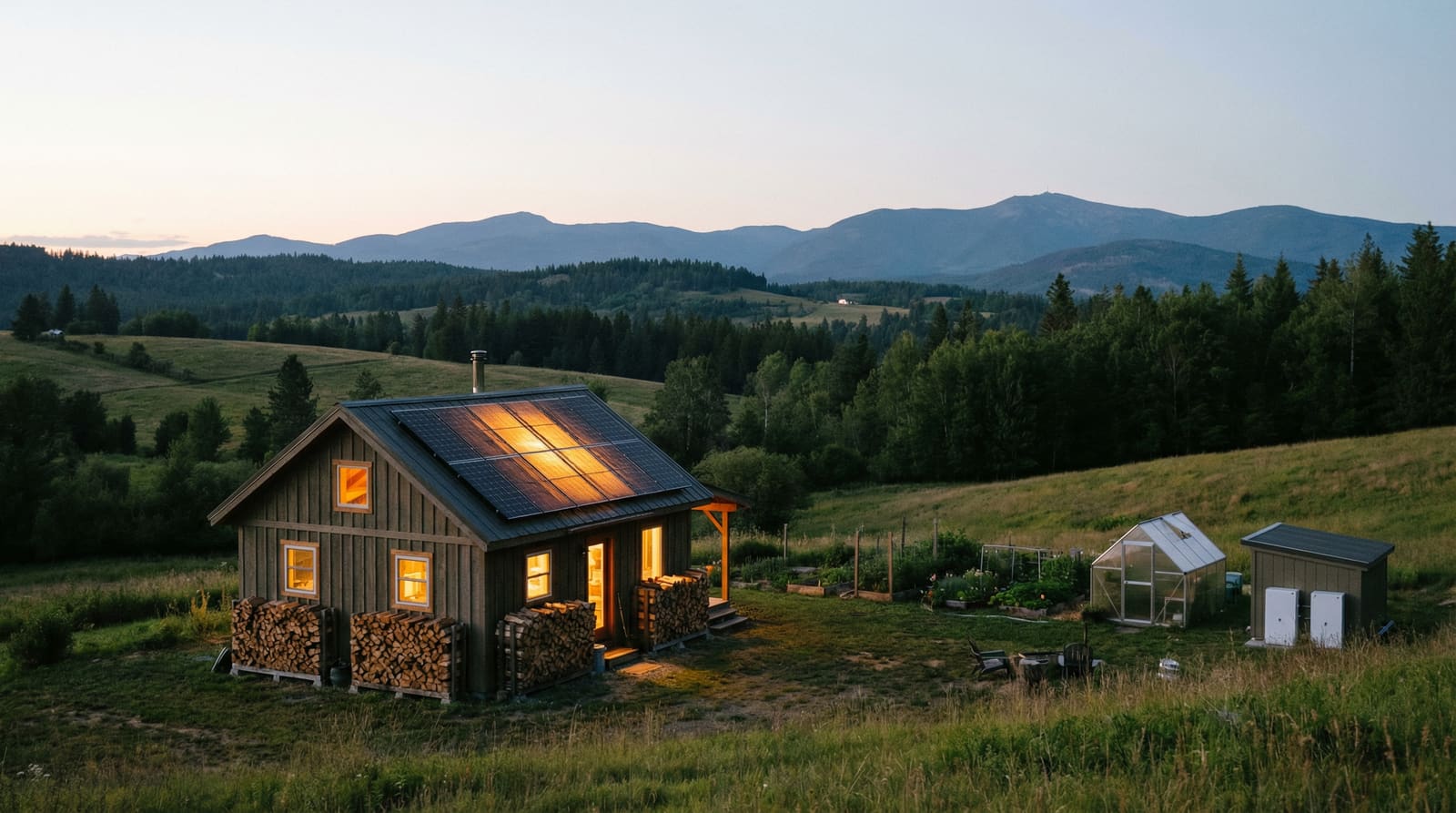
Electricity is the backbone of modern life. Producing your own energy is the most radical step toward autonomy: the difference between being a passive consumer, at the mercy of blackouts and tariffs, and an active producer.
12.1 Low-Cost Solar Water Heater
Heating water consumes a lot of energy. A passive solar system (thermosiphon) can greatly reduce that cost with a low investment.
- Collector: mount, in series, tubes or bottles painted matte black, inside a box with an insulated base and a transparent lid.
- Tank: place an insulated boiler at a level higher than the collector.
- Circulation: the cold water from the bottom sinks into the collector, is heated by the sun, and rises back to the top of the tank, no pump needed.
Be realistic about expectations. The collector made from PET bottles and milk cartons is excellent as an entry experiment, cheap and instructive, for you to understand the thermosiphon principle. On a good sunny day it pre-heats the water, with a gain in the range of 10 to 20°C, and it does not by itself deliver a hot 60°C shower for a 200-liter tank. The step up in quality is the flat-plate collector with a copper coil, or a dedicated solar boiler. Start with the PET version to learn, and invest in the plate when you want the definitive system.
Technical Sheet
- Cost
- Low, using recycled materials.
- Time
- 3 to 5 days.
- Realistic output
- Pre-heating of 10 to 20°C above the intake temperature, on a sunny day.
- Common mistakes
- Leaks at the joints; poor tank insulation; wrong collector tilt angle for your latitude.
- Maintenance
- Annual cleaning of the collector glass.
12.2 High-Efficiency Wood Stove (Rocket Stove)
The traditional wood stove is charming, but inefficient and polluting. The rocket stove burns the wood so completely that it produces almost no smoke, using a fraction of the firewood.
- "J" chamber: build a J-shaped combustion chamber with refractory bricks or a large can.
- Feed: the firewood goes in horizontally through the short arm of the "J".
- Internal chimney: the long arm is a chimney insulated with vermiculite or ash, where the gases burn at high temperature.
- Cooking: the heat rises and reaches the pot, placed on a stand just above.
My first rocket stove smoked more than a campfire. I had lavished attention on the combustion chamber and cut corners on exactly the part that matters, the insulation of the internal chimney. Without insulation, the gases cooled before burning completely, and the whole principle was lost.
I rebuilt it, packing ash and vermiculite around the tube. On the second try, the flame drew inward with that characteristic roar, almost smokeless. The lesson stuck: in a rocket stove, insulation is not the finish, it is the engine.
Technical Sheet
- Cost
- Low.
- Time
- 1 day.
- Efficiency
- Uses a fraction of the firewood of an open fire, with almost no smoke.
- Common mistakes
- Wrong chamber dimensions; insufficient chimney insulation; obstructed airflow.
- Maintenance
- Periodic ash cleaning.
Sanitation and Fertility
The complete cycle: from the earth back to the earth.
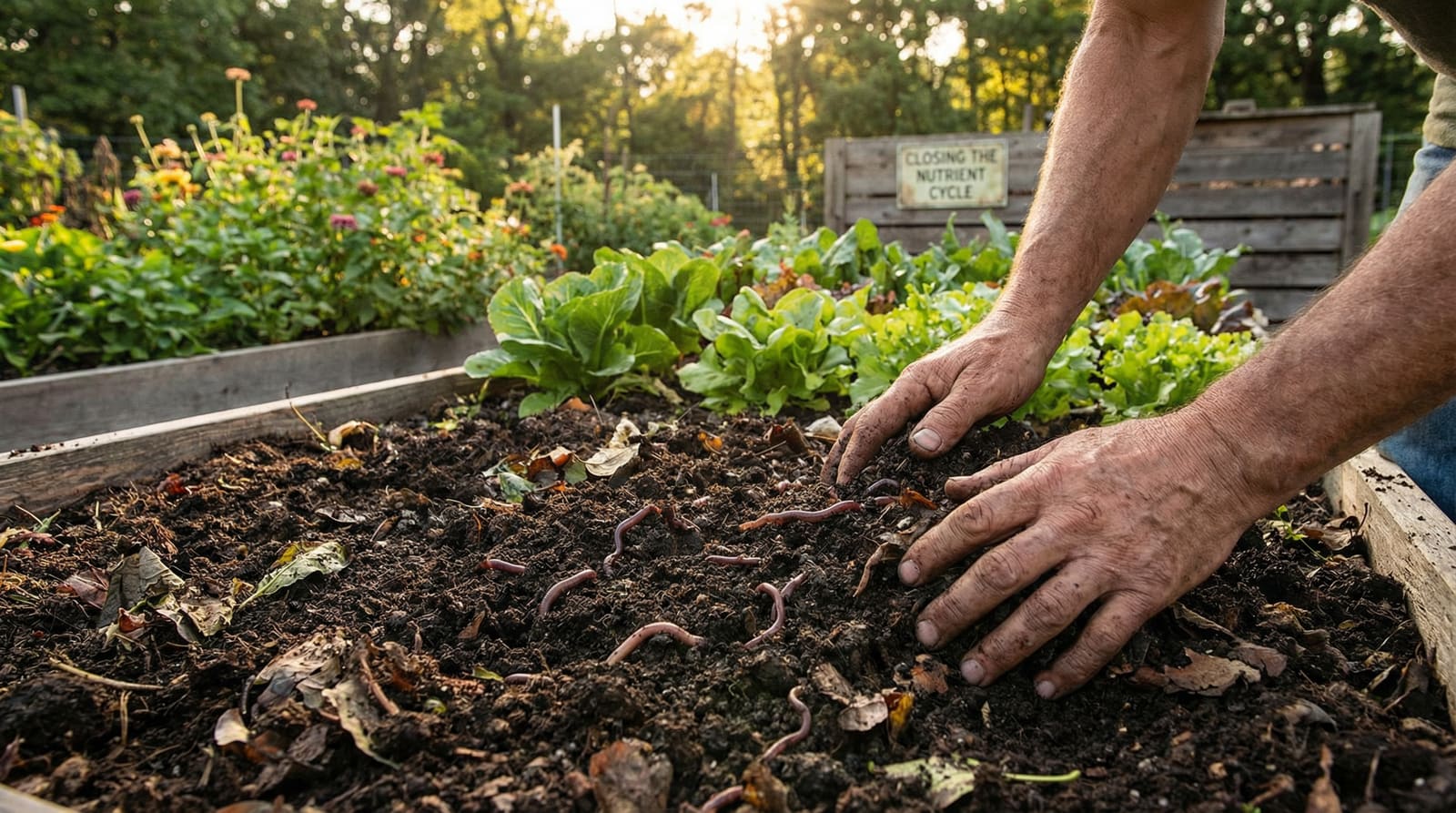
We live in a linear, insane system: we use drinking water to get rid of valuable nutrients, which then pollute our rivers. Closing that loop, treating our own waste and turning it into fertilizer, is the peak of ecological self-sufficiency.
13.1 Composting Dry Toilet
The dry toilet eliminates water use and turns a problem (waste) into a solution (compost).
- Structure: a simple booth with a raised seat.
- Container: below the seat, a bucket or barrel of 20 to 100 liters.
- Use: after each use, cover the waste with a generous layer of carbon-rich material (sawdust, dry leaves, ash). This eliminates the odor and balances the carbon-to-nitrogen ratio.
- Composting: when the container is full, take it to a dedicated compost pile, cover with more organic matter, and let it cure for at least 12 months.
Technical Sheet
- Cost
- Low.
- Time
- 2 days to build.
- Benefits
- Saves thousands of liters of water per year; high-quality compost.
- Common mistakes
- Not enough cover material (odor); composting too short; using it on root vegetables.
- Maintenance
- Emptying the container and managing the compost pile.
Your First 30 Days
The whole book leads to this point. Here is the antidote to becoming yet another reader who understood everything and did nothing. One month, four steps, starting small.
Do not try to do everything. The Friction Period rule applies here: one system at a time, one win at a time. This is one possible 30-day path, built to give a fast, visible result and hold your motivation. Adapt it to your space and climate.
The four-week plan
Set up a small bed (or pots) and plant fast-growing herbs and greens: lettuce, chives, basil, arugula. On the same day, start separating kitchen scraps into a bucket: your compost begins here.
Start your sourdough starter (it takes 7 days, so begin now) or, if you want something instant, make the citrus cleaner and your first jar of pickles. The idea is to produce something you would actually use, and prove to yourself that you can.
Install a simple harvesting setup: a gutter and a 200-liter barrel are enough to start. Add the first-flush diverter. This water is not for drinking yet, it is to irrigate the Week 1 garden. The loop starts to close.
With three systems running, you are no longer the person from Day 1. Choose your next bigger project based on your reality: the rocket stove, the solar heater, or the dry toilet. Plan it, gather the material, and begin Month 2.
Day 1 Checklist
If you close this book now, do at least this today. These are the first steps that require nothing beyond what you already have at home:
- Set aside a bucket in the kitchen and start collecting organic scraps (peels, coffee grounds, leaves).
- Reserve the sunniest corner of the yard or balcony for your first bed or pot.
- List three things you buy ready-made every week that you could produce (bread, seasoning, cleaner).
- Choose ONE of them to be your first system. Just one.
- Mark on the calendar the day of the week that will be your "build day".
The reader becomes a doer the moment the first seed goes into the soil. Everything before that is preparation. Everything after it is sovereignty.
What Comes Next
From individual sovereignty to collective possibility. Said once, with clarity.
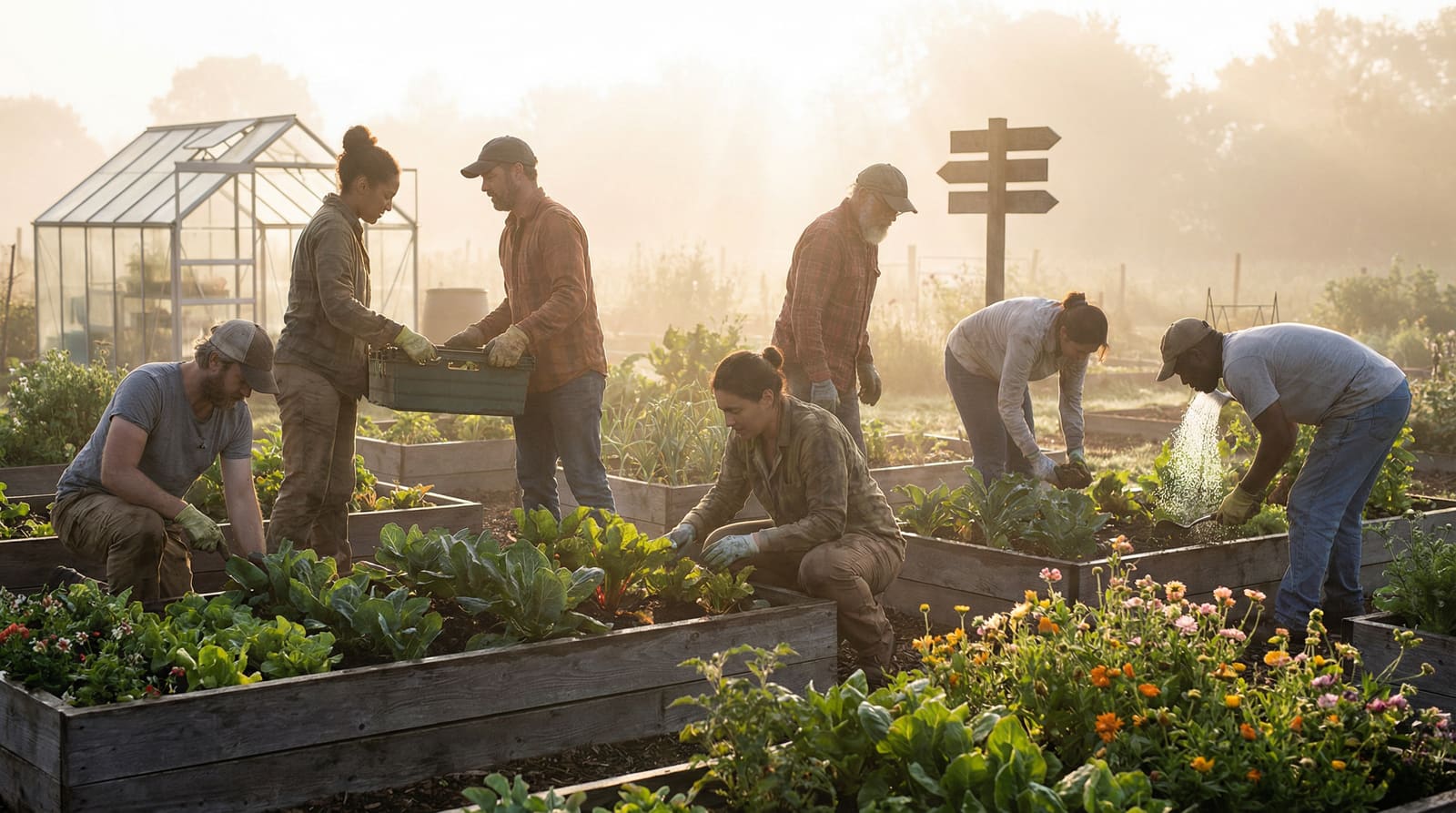
If you made it this far, self-sufficiency has stopped being an aesthetic idea and become a concrete project of reorganizing your own life. You learned that resilience is worth more than efficiency when the world turns unstable, that producing the basics changes your position in the economic game, and that autonomy is not the absence of rules, but the presence of structure.
The central point of this book was never to teach isolated recipes. It was to reorganize your perception. A house that produces part of what it consumes is stronger than one that depends only on fragile global chains. And that shift in perspective changes how you see risk, work, and the future: fear shrinks as competence grows; anxiety drops as dependence drops.
Along the way, you will notice something inevitable. When one person rebuilds their base, they gain stability. When two learn, cooperation appears. When several learn, structure is born. Community, in this context, is not an escape from society, it is the natural evolution of individual competence. It does not begin with a territory, a name, or a flag. It begins with people who learned to sustain their own lives and decided to do it together.
But there is an order that cannot be reversed. Organization without a base creates amplified dependence: when people still depend entirely on external systems to survive, community only multiplies the fragility it meant to overcome. What cannot be improvised is character. People who take responsibility for their own mistakes, who produce before they demand, who understand that freedom and discipline go together, those are the only foundation of a functional group.
So if one day you choose to live near others who share these principles, it will not be out of desperate need, but out of strategic vision. Cooperation among mature people multiplies stability. Cooperation among fragile people only amplifies fragility. Collective sovereignty begins, inevitably, with individual sovereignty. This is what I call competence before expansion: you never grow as a collective what you cannot yet sustain standing alone.
Sovereignty is not born of speeches. It is born of systems that work. And building the first system is your responsibility. The moment is not in the future. It is now.
None of this requires you to abandon your current life or make extreme decisions. The journey begins in the space you already have: in your kitchen, in your yard, in your decision to learn. Begin. Test. Fail. Adjust. Repeat. Every system you build strengthens your base. The rest follows as a natural consequence of what you decided to build.
Structuring a 20-Person Community Nucleus
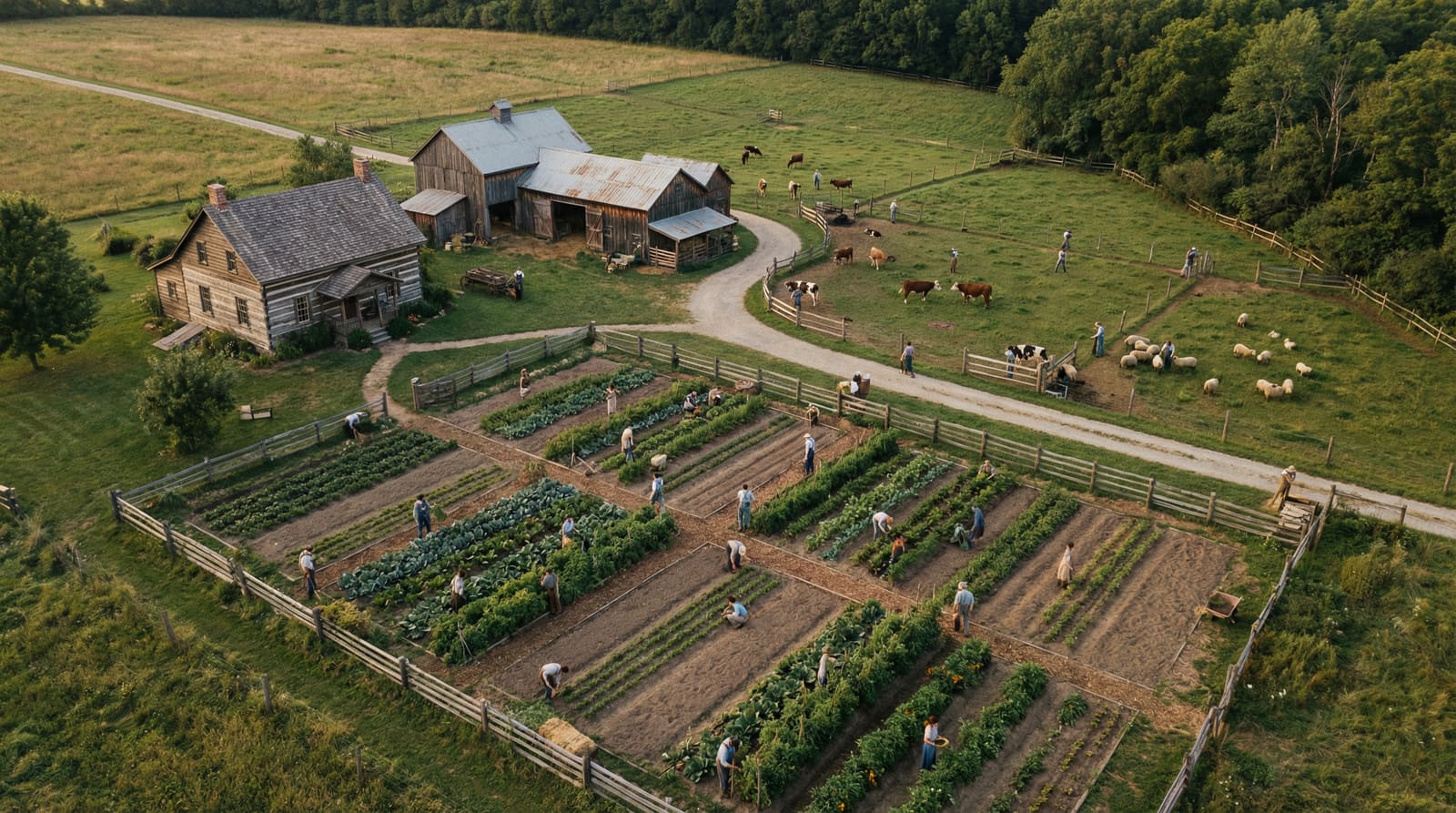
To turn the idea of an organized nucleus into something concrete, let us outline the basic needs for a group of 20 adults.
1. Minimum Recommended Area
Total: 10 to 20 hectares.
| Zone | Area | Function |
|---|---|---|
| Housing and infrastructure | 1 to 2 ha | Houses, workshops, processing, storage, and common areas |
| Agroforestry systems and gardens | 4 to 6 ha | Vegetables, grains, fruit, and roots at scale |
| Pasture | 3 to 5 ha | Rotational grazing for goats, sheep, or cattle |
| Preservation and forest management | 2 to 7 ha | Ecosystem health, firewood, timber, and organic matter |
2. Minimum Food Production (annual estimates)
| Category | Product | Estimate per year |
|---|---|---|
| Calories (grains) | Corn, wheat, oats | 800 to 1,200 kg |
| Calories (roots) | Potato, cassava, sweet potato | 2,000 to 3,000 kg |
| Protein | Beans, lentils, chickpeas | 300 to 500 kg |
| Protein | Eggs (10 to 15 hens) | 2,500 to 3,500 eggs |
| Protein | Milk (4 to 6 goats) | 3,000 to 5,000 liters |
| Vegetables and fruit | Continuous production (agroforestry and gardens) | Focus on preserves for the off-season |
3. Water Harvesting and Storage
| Parameter | Value |
|---|---|
| Human use (drinking, cooking, hygiene) | 150 L/person/day = 3,000 L/day = ~1,100,000 L/year |
| Irrigation and animals | Highly variable; can double the total need |
| Recommended storage | Cisterns of 100,000 to 200,000 liters |
| Recommended sources | Rainwater harvesting + well + spring or watercourse |
4. Basic Energy Structure
Estimated consumption: about 150 kWh/month per family of 4, roughly 750 kWh/month for the group.
| Source | Specification |
|---|---|
| Solar photovoltaic (off-grid) | A 10 to 15 kWp system with a 40 to 60 kWh battery bank |
| Water heating | Solar thermal collectors for bathing and cooking |
| Biogas | Digesters to supply part of the cooking gas |
| Mechanical energy | Manual and low-tech tools wherever possible |
5. Suggested Work Division
| Group | People | Responsibilities |
|---|---|---|
| Agriculture | 6 to 8 | Planning, planting, management, and harvesting |
| Livestock | 2 to 3 | Animal care, milking, egg production |
| Processing and preserves | 3 to 4 | Bread, cheese, jams, canned goods, and the shared pantry |
| Infrastructure and maintenance | 3 to 4 | Energy, water, building, and equipment repair |
| Health and education | 1 to 2 | Natural pharmacy, first aid, and education |
6. Minimum Collective Fund
| Component | Details |
|---|---|
| Initial capital | Founders' contribution for land and basic infrastructure (tractor, solar system). Highly variable. |
| Annual maintenance fund | A modest per-person yearly contribution pooled for the group |
| Fund use | Fuel, parts, veterinary costs, specialized medical expenses, land taxes |
| Production surplus | Sold at markets or to restaurants, generating extra income |
These numbers are not romantic idealizations, but practical estimates that size up what is possible when production and organization are handled with discipline. When surplus is structured with purpose, it converts into amplified stability, and into the capacity to sustain something larger than the operation that generated it.
Toward Book 2
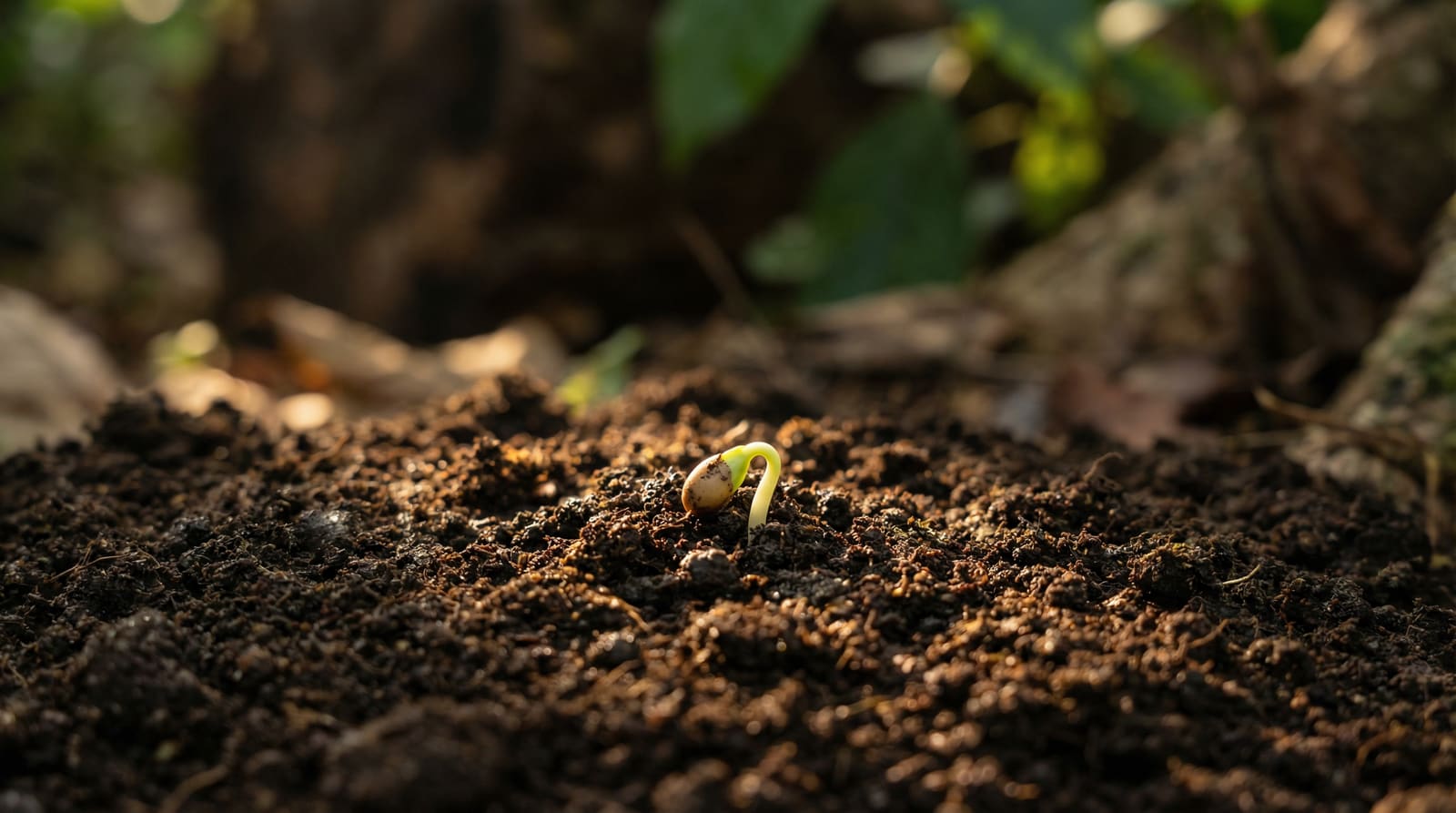
This Book 1 was about the foundation: rebuilding the individual's material and psychological base. It showed that sovereignty begins in the kitchen, in the yard, in how you produce and consume. That autonomy is not a speech, but a system that works.
Book 2 is about the next cycle, and it does not begin with territory or legal formalization. It begins with mutual recognition among individuals who walked the same path. People who already understood that sovereignty is not born of convenience, but of competence. Governance that emerges from demonstrated capacity, not from rhetoric. An internal economy sustained by measurable contribution, not by abstractions. Clarity between what belongs to the individual and what sustains the collective. Honest criteria for who joins and who stays.
None of this requires haste or immediate commitment. The journey remains individual. But if one day you realize you have found others who share this vision and this level of responsibility, you will know you are facing the opportunity to expand. What comes after will not be ideology, it will be construction. Not escape, but strategy. Not utopia, but engineering applied to real life.
Andre Alves has been an entrepreneur since childhood. At eighteen he was a manager at the Rio Olympic Games, then built companies that grew outside Brazil, and took a biomedical engineering research project to NCUR 2024. It was while raising his own house with the clay of his own land, making eco-brick, that Rocket Eco Homes was born.
When the time came to expand the factory, the question that broke the line appeared: why one more company, and why more possessions. None of the answers he had held up. Today Rocket Eco Homes belongs to a foundation governed by the communities themselves, and he keeps nothing of what it earns. He wrote this book not so you can live his life, but so you have the tools to build your own and reach what your heart is after. This is the first of three books about that crossing.
Book 2 is out
This book was about one house and one family. The next one is about what no family manages alone: how a group chooses itself, decides, shares work and property, and survives its first conflict. It is a manual for building a community anywhere. It is published in Portuguese today, and an English edition is on the way.
Read Book 2 (in Portuguese)